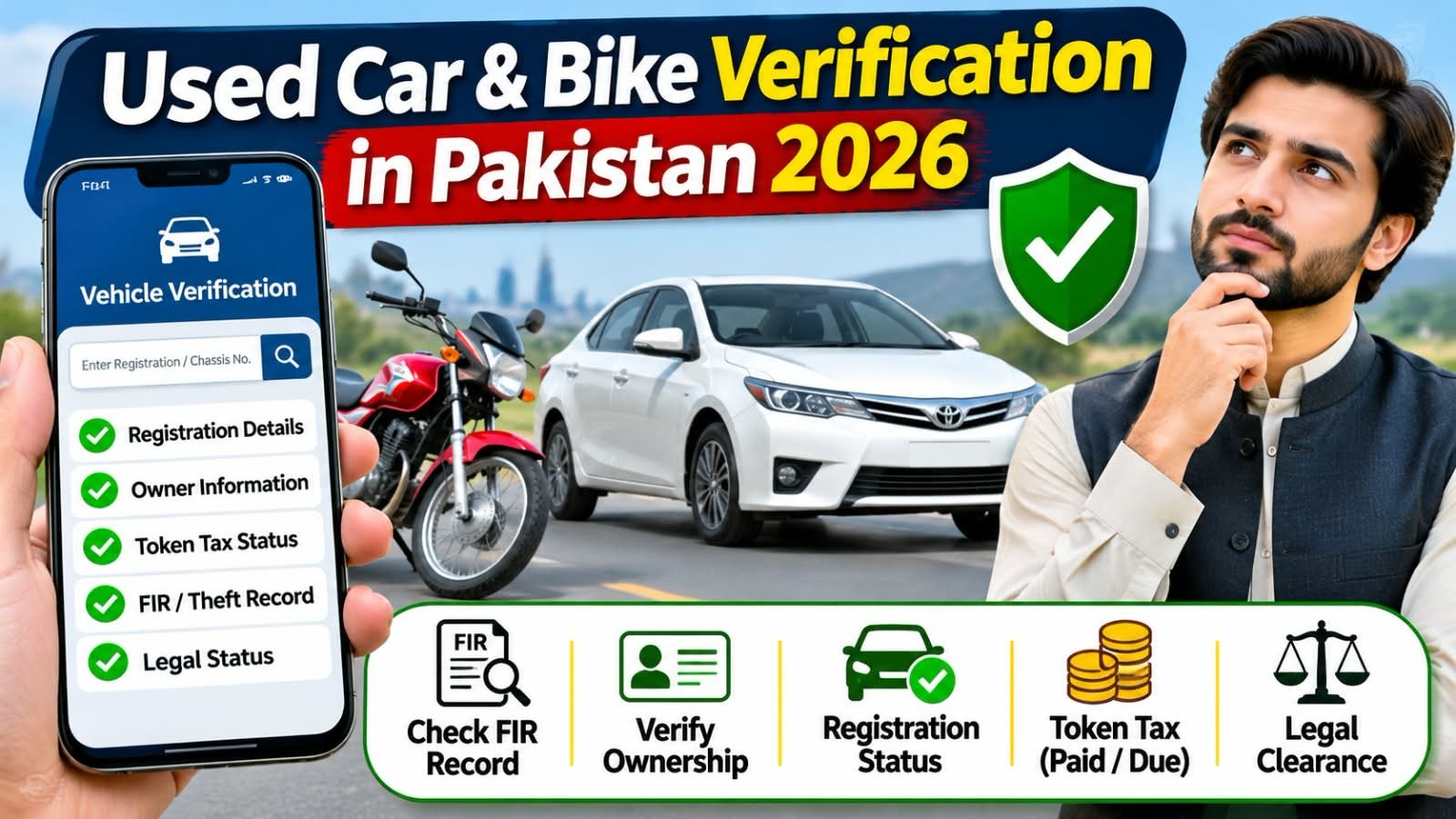
Used Car & Bike Verification in Pakistan 2026 | Check FIR, Registration & Legal Status
Buying a used car or motorcycle can save you money, but one mistake can turn a good deal into a serious legal and financial problem. Before paying the seller, you should verify whether the vehicle is properly registered, whether the ownership details match, whether taxes are cleared, and whether the vehicle has any stolen or suspicious record.
In Pakistan, vehicle verification is handled through provincial Excise departments and police systems. For example, Punjab provides an official online registered-vehicle verification service, while Punjab Police’s Anti-Vehicle Lifting System (AVLS) maintains records related to stolen and snatched vehicles.
Here is a practical 2026 guide to checking a used car or bike before purchase.
Why Used Vehicle Verification Is Important
A seller may show you registration documents and claim that everything is clear. However, documents alone should not be your final decision.
A proper verification can help you identify:
– Incorrect or suspicious registration details
– Ownership mismatches
– Unpaid token tax or other dues
– Engine or chassis number discrepancies
– Stolen or snatched vehicle records
– Fake or unauthorized number plates
– Problems with the transfer of ownership
KP authorities, for example, have continued enforcement against unregistered vehicles, fake number plates and token-tax defaulters, highlighting the importance of checking a vehicle’s legal documentation before purchase.
Step 1: Check Vehicle Registration Online
The first step is to verify the registration number through the official Excise & Taxation Department of the province where the vehicle is registered.
In Punjab, the Excise Department provides an official Online Verification of Registered Vehicles service through its MTMIS system.
Depending on the province and available service, verification may provide information such as:
– Registration number
– Make and model
– Chassis number
– Engine number
– Registration details
– Owner-related information
– Tax or token status
Never rely solely on a screenshot supplied by the seller. Open the official government website yourself and perform the verification.
Step 2: Match the Chassis and Engine Numbers
This is one of the most important checks when buying a used car or bike.
Locate the vehicle’s chassis/VIN and engine number and compare them carefully with the registration book/card and official online record.
Look for:
– Missing or altered digits
– Scratched or tampered numbers
– Different engine numbers
– Different chassis/VIN numbers
– Signs that a plate has been replaced or modified
If the physical vehicle and government record do not match, do not complete the purchase until the discrepancy is officially explained and resolved.
Step 3: Check for Stolen or Snatched Vehicle Records
Registration verification and stolen-vehicle verification are related but not necessarily the same thing.
Punjab Police’s AVLS maintains a province-wide database of stolen and snatched vehicles and is integrated with police and Excise systems.
This is why a buyer should not simply ask, “Is this vehicle registered?” Instead, ask whether the vehicle has any stolen, snatched or police-related record.
Where an online public stolen-vehicle search is unavailable, visit the relevant police facilitation centre or police authority with the vehicle’s registration and identification details.
Step 4: Verify the Seller and Ownership Transfer
Make sure the person selling the vehicle has the legal authority to sell it.
Ask for:
1. Original registration documents
2. Seller’s CNIC
3. Vehicle registration number
4. Chassis/VIN number
5. Engine number
6. Previous ownership/transfer documents where applicable
Do not hand over the full payment simply because the seller promises to transfer the vehicle later.
Punjab’s Excise system supports vehicle ownership-transfer processes, including biometric verification.
Step 5: Check Token Tax and Outstanding Dues
A vehicle may look physically perfect but still have outstanding government dues.
Before purchasing, check the applicable token tax and other Excise-related liabilities through the official provincial system.
Also ask the seller for proof of recent payments rather than accepting verbal confirmation.
Step 6: Get a Physical Inspection
Government verification tells you about registration and legal records, but it does not replace a mechanical inspection.
Before purchasing, have a trusted mechanic inspect:
– Engine condition
– Gearbox
– Suspension
– Brakes
– Accident damage
– Welding or structural repairs
– Electrical system
– Tyres
– Air-conditioning
– Signs of flood or water damage
A vehicle can have a completely legitimate registration record and still be mechanically unsafe or heavily damaged.
Important Safety Tip: Don’t Trust “Urgent Sale” Pressure
Be especially careful if someone says:
«“Pay today because another buyer is waiting.”»
A genuine vehicle can normally be verified before payment. Take your time, verify the records independently and avoid sending large advance payments to an unknown seller.
Final Checklist Before Buying
Before purchasing a used car or bike in Pakistan, confirm:
– Registration is verified through the relevant Excise authority
– Chassis/VIN matches the official record
– Engine number matches the documents
– Ownership information is consistent
– Token tax and dues are checked
– Stolen/snatched status is investigated
– Number plate appears legitimate
– Seller’s identity is verified
– Ownership transfer process is clear
– Vehicle has been physically inspected
Conclusion
A used car or bike is not simply a mechanical purchase—it is also a legal and financial transaction. Spending a little time on vehicle verification can protect you from stolen vehicles, ownership disputes, unpaid dues and expensive legal problems.
The safest approach in 2026 is simple: verify the vehicle through official government channels, physically match its identification numbers, investigate its police status, and complete the legal ownership transfer before considering the deal finished.